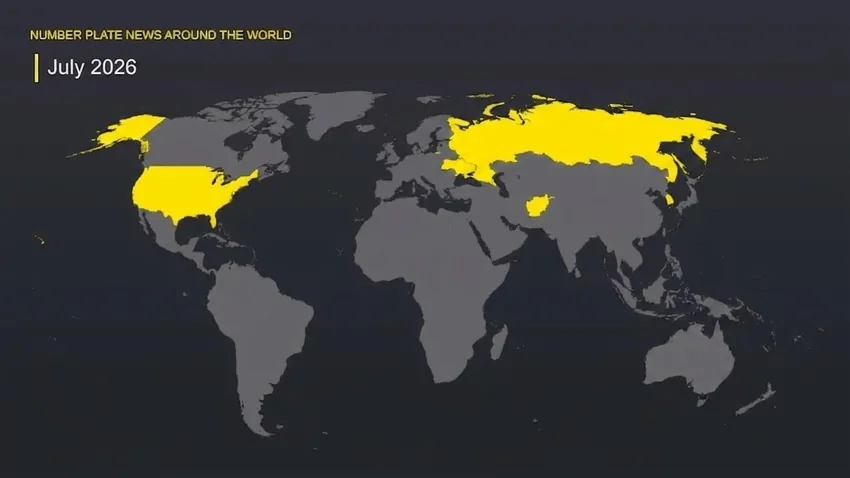
Russia: Many Russian regions introduce fuel rationing by licence plate
Russia is experiencing an ongoing fuel crisis, prompting rationing and the introduction of various other measures aimed at conserving fuel, and reducing chaos and congestion at filling stations.
An increasing number of Russian cities and regions have launched systems whereby motorists are allocated days to fill their fuel tanks. Which day each driver is allocated is decided by the first character in their vehicle's licence plate number.
The scheme was proposed in June by Andrei Klychkov, Governor of Oryol, the administrative city of Oryol Oblast in Russia. On 4 July, the Oryol region became the first area to go ahead and implement the scheme.
The system is a variant of one that has been used in several countries in the past. The proposal believed to have been adopted in Oryol described a schedule where vehicles with plates beginning with 0 or 1 could fuel up on Saturdays, those with 2 or 3 on Sundays, those with 4 or 5 on Mondays, and so on up to the number 9.
The unsettled fuel situation in Russia is largely attributed to supply disruption by Ukrainian drone attacks.
Afghanistan: Taliban bans the issue of licence plates for right-hand-drive vehicles
Afghanistan's theocratic government, the Taliban, is moving toward a ban on right-hand-drive vehicles on the country's roads. It has long been felt that right-hand-drive vehicles present a road safety hazard in Afghanistan.
In the most recent development, Interior Ministry spokesman Abdul Mateen Qani stated that licence plates will no longer be issued for right-hand-drive vehicles. He went on to say that relevant authorities are considering whether or not to modify the steering systems of right-hand steering cars. In the capital, Kabul, all right-hand drive vehicles will be banned from the city's roads.
Most of Afghanistan's right-hand-drive vehicles are imports from neighbouring countries. Their incompatibility with Afghanistan's traffic systems has raised allegations of increased accidents, and calls for them to be banned.
USA: Rumours plague Indiana's new 'blackout' licence plates
So-called blackout licence plates are becoming increasingly popular in the USA. In contrast to the colourful or pictorial designs available on custom plates in many states, blackout plates offer a classic, minimalist palette of white characters on a plain black background.
Unfortunately, the rise in blackout plate popularity coincides with an increase in concern over state and law-enforcement surveillance of citizens by use of ANPR/ANLPR systems that read licence plates and store details in law enforcement databases.
In Indiana, rumours are rife that the blackout plate colour scheme is easier for plate recognition cameras, such as those operated by the controversial company Flock, to read.
Indiana State Police have attempted to set the record straight by stating that Automated Licence Plate Recognition cameras can read all Indiana plates with the same efficiency and accuracy as the blackout versions of plates. The police went on to clarify that the colour and design of a license plate do not impact the camera’s ability to read it.
South Korea: City officials cheat plate allocation system
An internal audit at the district office of the city of Gwangju revealed that officials have manipulated the city's "random" licence plate allocation system for their own benefit.
Employees of the district office gamed the system in order to obtain coveted character combinations, termed "golden numbers" rather than allowing them to be randomly issued to citizens as the system was designed to do. The so-called “golden numbers” included repetitive combinations such as 7777 and 5555. Also numbers with three repeated digits such as 6999 and 8880, and symbolic or homophone numbers such as 1004, which when read aloud sounds similar to the Korean word for “angel".
Gwangju officials announced that they would pursue disciplinary action against those who had misused the system in this way between 2023 and February 2026. The audit, conducted between February and May 2026, placed 16 employees of the transportation administration division under scrutiny.
Of the 16 employees investigated, 10 were deemed to have taken part in the manipulation of the system. Six of those employees will probably face disciplinary review. Others may receive lighter penalties, warnings or reprimands.
Ukraine: Petition to eliminate front number plates on cars struggles for support
An online petition started in Ukraine calls on the government to remove the requirement to display front number plates on passenger cars. The petition's instigator wants the government to change the current rules to allow the use of just a rear plate. The petition author claims that front number plates detract from the appearance of cars, especially those models that weren't designed to have front plates fitted. The author also claims that mounting front plates often requires drilling into the bumper or using special frames, both of which can damage the vehicle.
Instead of using front number plates, the petition author suggests more use of automatic camera systems, and databases that store cars' licence plate numbers and VIN codes.
The petition was opened on July 6. To be considered by the Cabinet of Ministers, the petition would need 25,000 signatures. It seems that the author has some campaigning to do, as a check on July 7 showed that only 40 people had signed the petition.


