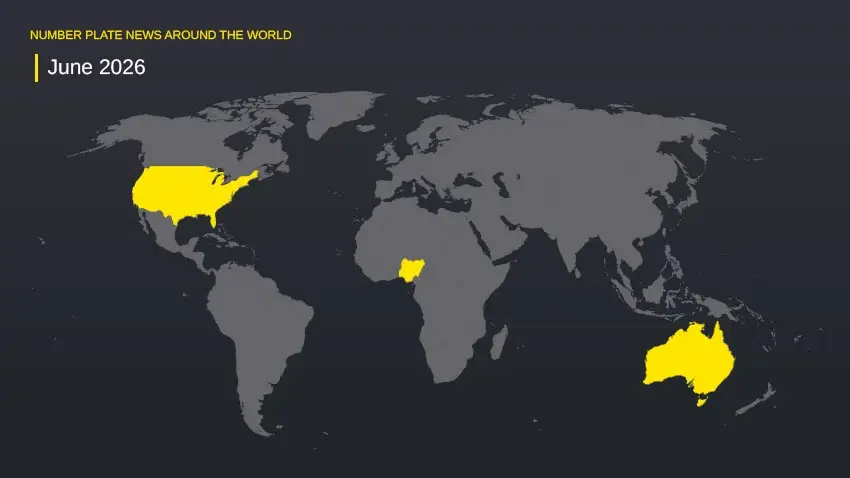
Nigeria: Police take nationwide action against illegal number plates
Nigeria's Inspector-General of Police, Olatunji Disu, has instigated a countrywide police operation targeting cars with missing, hidden or altered number plates. Mr Disu announced that the enforcement drive is intended to strengthen security and prevent criminal activities. He warned that drivers who break Nigeria's vehicle registration laws will face penalties.
The operation has already seen local officers in many areas charge motorists with plate-related offences. In Plateau State, 14 vehicles have been impounded and their owners and drivers charged with a variety of offences, including the use of unregistered vehicles, concealment or defacement of number plates, unauthorised display of foreign plates, and replacement of approved registration identifiers with unofficial logos or other non-regulation designs.
Bassey Ewah, Plateau State's Commissioner of Police, said, “The command will not tolerate any attempt to frustrate lawful identification of vehicles within Plateau State. These measures are preventive and security-driven.”
Australia: New plates for Chinese imports
The personalised number plate service in the Australian state of Victoria has responded to the success of Chinese car imports into Australia by offering new number plate designs specifically for Chinese cars.
In May this year, imports of Chinese cars into Australia overtook those of Japanese cars for the first time. Previously Japan had been the longstanding biggest overseas supplier of cars to Australia. In 2025, China had to settle for second place, displacing Taiwan, the former holder of that position.
Victoria’s VPlates service responded by announcing a new plate design tailored for the Chinese vehicles that are pouring onto Australia's car market. The new plates come with pre-drilled holes spaced at 224mm apart, which matches most Chinese cars. Front plates measure 372mm wide by 132mm tall, and rear plates are 305mm wide by 155mm tall. The cost for a set of the new number plates is $175 AUD.
The state of Victoria already offered plates made to fit Japanese cars.
Australia: A big auction sale
Staying down under, and still in the state of Victoria, an auction held at the end of May 2026 saw 12 private number plates sell for a combined total of $2 million AUD.
We reported last month that Victoria had been lagging behind other states in only allowing plates to display a maximum of six characters. That recently changed, with seven-character plates being introduced, and, to mark the additional customisation possibilities offered by the extra character, 12 special plates were offered for sale at auction: 1111111, AAAAAAA, MCLAREN, 1234567, 6666666, PORSCHE, 7654321, XXXXXXX, 9999999, 8888888 and FERRARI.
The ‘FERRARI’ plate was the top performer with a winning bid of $328,000. ‘8888888’ sold for $270,000, the ‘1111111’ plate sold for $190,000, and the '9999999' number plate for $185,000.
VicRoads also offered a ‘Winner’s Choice’ lot. This appealing option, which enabled the successful bidder to select any available seven-character combination, subject to standard eligibility, approval and availability, sold for $202,000.
USA: Department of Justice sues four states for refusing to allow undercover license plates for ICE agents
President Trump's Department of Justice (DoJ) is launching legal proceedings against the American states of Maine, Massachusetts, Oregon and Washington over those states' denying undercover vehicle licence plates to agents of the controversial Immigration and Customs Enforcement (ICE) agency. ICE's stated purpose is to conduct criminal investigations, enforce immigration laws, preserve national security, and protect public safety. During Trump's presidency, however, the agency has gained a reputation for heavy-handedness, violence and indiscriminate targeting of American citizens and legally documented immigrants. Many communities have demonstrated resistance to ICE activities.
Officials in Maine and Massachusetts have said that aggressive tactics by ICE agents meant that they did not want to dedicate state resources to enabling covert civil immigration enforcement. A counter argument from the DoJ claims that the four states concerned unlawfully discriminate against the federal government in violation of the US Constitution by treating ICE differently from state and local law enforcement agencies.
The justice department said that the states' policies threaten the safety of federal immigration agents, exposing officers to harassment, tracking and assaults while they carry out arrests.
Acting US attorney general, Todd Blanche, said, “Law enforcement officers risk their lives every day to keep Americans safe and must be able to carry out their duties effectively."
However, Massachusetts governor Maura Healey issued a statement saying that the state supports legitimate criminal investigative work but added, “That’s not what we are seeing from ICE.”
USA: New ANPR surveillance tech has international implications
A new surveillance technology SignalTrace could enable the tracking of more than just number plates and cars. The technology, developed by US defence contractor Leonardo, can track the phones, smartwatches, wireless earbuds and other electronic devices of car occupants and cross-reference that data with ANPR information that identifies cars. This means that it would be possible for those operating the system to know the identities of a vehicle's driver and passengers without stopping the vehicle or asking the occupants for their details.
According to reports from digital media company 404 Media, SignalTrace is able to link ANPR data to identifiers collected from a range of devices, including mobile phones, Bluetooth-enabled wearables and RFID-enabled devices (such as workplace access badges and pet microchips).
A data sheet presented by 404 Media says:
When multiple devices consistently move together with a vehicle, SignalTraceʼs algorithms link them to that vehicleʼs license plate and time-stamped location data. This correlation provides investigators with another layer of actionable intelligence, even if a suspect changes or removes a plate.”
Privacy advocates have long raised concerns about automated license plate readers. The Electronic Frontier Foundation has said that repeatedly capturing images of vehicles at different locations can reveal a person’s “pattern of life” and even identify people they regularly associate with.
The company has not yet commented on privacy concerns surrounding SignalTrace.
Leonardo, the company behind SignalTrace has said that the system does not decrypt or capture the contents of the devices or their communications and that SignalTrace simply stores data until a specific request is made of the system by an investigator after a crime has occurred.
Privacy advocates in several countries have expressed concern over the privacy implications of the system.


