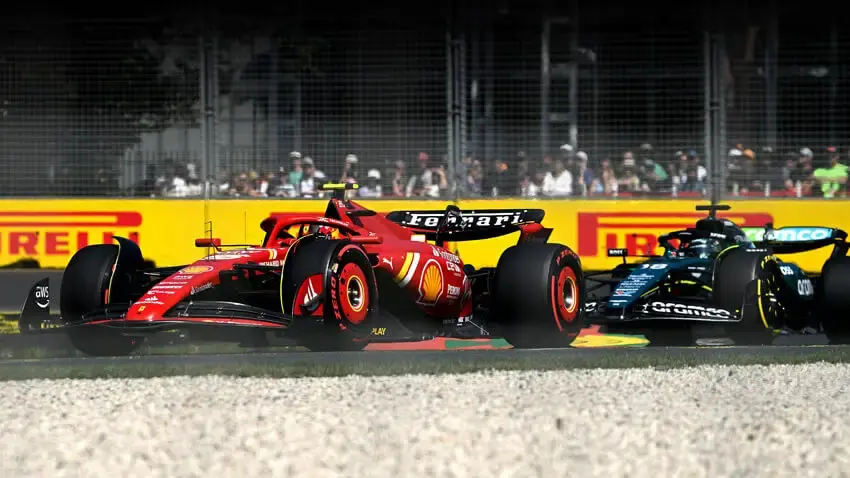
Motor racing is huge, and its crowning glory, Formula One (F1), has a global following of over 800 million fans. With that kind of audience, F1 has no problem attracting substantial revenue from sponsorship, advertising and broadcasting deals.
At the time of writing, Formula One, in the shape of Formula One World Championship Limited and its parent company, The Formula One Group, is valued at $25.89 billion USD (over £19 billion). Despite its popularity as a sport, and its size as a business, not everyone follows, nor even understands Formula One. So, for the uninitiated, here's a short introduction.
What even is Formula One anyway?
With that £19 billion valuation in mind, someone who is not really familiar with the sport might be forgiven for wondering if the eponymous "formula" is a magic formula for making money. In reality, the formula refers to the rules and specifications with which competing cars must comply. In a sport, it is primarily the ability of the athlete or, in this case, the driver that is being tested, not the quality of their equipment, so a fixed set of standards and limitations ensures something of a level playing field - or level race track
The establishment of such a formula was suggested before the outbreak of the Second World War but, understandably, its introduction was delayed until after hostilities ceased. The first World Championship governed by the new rules took place in 1950. That was the forerunner of today's FIA Formula One World Championship.
The rules and the formula we mentioned above are the responsibility of the Fédération Internationale de l'Automobile, while the business interests of Formula One as a sport are controlled by the Formula One Group, a group of companies whose mission is to promote the commercial aspects of the sport. Formula One Group, founded and previously part-owned by Bernie Ecclestone, has been owned by American mass media company Liberty Media Corporation since 2017.
The sport of Formula One
Although most of the attention is focused on the drivers, Formula One has a championship for racing teams or constructors too. The drivers' champion is decided by one points system, while the constructors' champion is decided by another.
The World Championship is divided into seasons, each of which consist of a series of races, the famous grands prix that almost everyone has surely heard of.
The Grand Prix
Grand prix events are held over weekends, usually from Friday to Sunday. The event consists of practice sessions followed by a qualifying session. The main race, in which the championship points are scored, usually takes place on Sunday.
The results of the qualifying session determine the starting order and position of each car on the grid from which the main race begins. Typically, the cars are arranged on the starting grid in ten rows of two, in marked-out positions on the track. The cars that were fastest in the qualifying session go at the front of the grid, in what is known as pole position. Cars that start in pole position have an advantage from the outset as they aren't obstructed by cars in front of them. However, nothing is guaranteed.
The number of grands prix taking place in a Formula One season can vary. The inaugural season that took place in 1950 comprised seven races, whereas the 2024 and 2025 seasons each comprised 24 grands prix, equally sharing the distinction of the most ever grands prix in a season. It is more common for 19 or 20 grands prix to take place in one season. Grand prix races take place all around the world.
Historical and Current Formula 1 Grand Prix Host Nations
Formula 1 Global Host Nations: Current vs Historic
NB: Hosts for the 2026 season are indicated bold.
| Country | Circuit | Year |
|---|---|---|
| Argentina | Autódromo Oscar Gálvez | 1998 |
| Australia | Albert Park (Melbourne) | 2026 |
| Austria | Red Bull Ring | 2026 |
| Azerbaijan | Baku City Circuit | 2026 |
| Bahrain | Bahrain International Circuit | 2026 |
| Belgium | Spa-Francorchamps | 2026 |
| Brazil | Interlagos (São Paulo) | 2026 |
| Canada | Circuit Gilles Villeneuve | 2026 |
| China | Shanghai International | 2026 |
| France | Circuit Paul Ricard | 2022 |
| Germany | Hockenheimring | 2019 |
| Hungary | Hungaroring | 2026 |
| India | Buddh International | 2013 |
| Italy | Monza | 2026 |
| Japan | Suzuka Circuit | 2026 |
| Malaysia | Sepang International | 2017 |
| Mexico | Autódromo H. Rodríguez | 2026 |
| Monaco | Circuit de Monaco | 2026 |
| Morocco | Ain-Diab | 1958 |
| Netherlands | Zandvoort | 2026 |
| Portugal | Portimão (Algarve) | 2021 |
| Qatar | Lusail International | 2026 |
| Russia | Sochi Autodrom | 2021 |
| Saudi Arabia | Jeddah Corniche | 2026 |
| Singapore | Marina Bay Street | 2026 |
| South Africa | Kyalami | 1993 |
| South Korea | Korea International | 2013 |
| Spain | Madrid (Street) / Barcelona | 2026 |
| Sweden | Scandinavian Raceway | 1978 |
| Switzerland | Circuit Bremgarten | 1954 |
| Turkey | Istanbul Park | 2021 |
| United Arab Emirates | Yas Marina | 2026 |
| United Kingdom | Silverstone | 2026 |
| United States | COTA / Las Vegas / Miami | 2026 |
The competitors
Motor racing, particularly Formula One, is unusual insofar as both car and driver can be winners. In that respect, it's unlike almost any other sport. There are, after all, no equivalent prizes for the designers of well-performing cricket bats, football boots or boxing gloves. On the Formula One race track, drivers compete with each other, but so do designers and engineers.
Drivers
Of course, driving is perceived as the most glamorous job: it's certainly the most hazardous. Accidents are all too common at race events, and lives have been lost as a result. At the time of writing, available data indicates that at least 32 drivers have died at Formula One weekend events.
Many Formula One drivers worked their way up from lower-tier racing. In the case of seven-time Formula One World Drivers' Champion Lewis Hamilton, his early career began with him driving go-karts. Many of Hamilton's heroes and peers started the same way, including Ayrton Senna, Nigel Mansell, Michael Schumacher, Fernando Alonso, Kimi Räikkönen, Lewis Hamilton, Sebastian Vettel, Nico Rosberg, and Max Verstappen.
In karting, the fastest competitive vehicles, so-called superkarts can reach speeds of 100 mph. By the time drivers graduate to today's Formula One, they are driving cars that can achieve speeds of over 230 mph.
Constructors
At the heart of a Formula One team are its designers and engineers. As well as creating chassis, engines and body forms that work together to deliver maximum speed and efficiency, the team must work with safety uppermost in their minds. A car travelling at 200+ mph presents a potentially lethal hazard to drivers and bystanders if anything should go wrong.
And, of course, all competing cars must comply with the famous Formula, that set of rules and specifications that define Formula One racing cars.
Within the sport, the very best designers and engineers are heroes at least on a par with superstar drivers. To real devotees, people like Adrian Newey, John Barnard, Rory Byrne, James Allison, Colin Chapman and their peers and predecessors are as famous as Lewis Hamilton, Michael Schumacher and Sterling Moss.
Fanatical about cars
F1 demands focus and dedication at all levels. When lives and careers are on the line every time a driver gets behind the wheel, there is no room for fault or error. And when things are that intense, it is hardly surprising that, for many of the people involved, it is hard to just switch off, and so cars seem as essential to their lives as the food they eat and the air they breathe. The obsession sometimes borders on all-consuming and this is reflected in the cars that drivers and constructor team members drive away from the racing circuit.
Fernando Alonso and Max Verstappen are both known to be fans and owners of the Aston Martin Valkyrie. Alonso has also owned an Aston Martin Valiant, a Ferrari 599 GTB 60F1 and a Ferrari LaFerrari. Lewis Hamilton has also owned a LaFerrari. He has also owned a McLaren F1 and a McLaren P1. Lando Norris has chosen the Lamborghini Miura and the Porsche Carrera GT.
Designer Adrian Newey has an amazing collection of supercars, including an Aston Martin Valkyrie, an Aston Martin DB6, an Aston Martin DB4 GT, a McLaren F1, a couple of Ferrari 250GTs and more.
Fanatical about number plates
With an addiction to nice cars comes an appreciation of good private registration numbers. As one might expect, Regtransfers is proud to count Adrian Newey amongst our valued customers. Top motorsport executives Ron Dennis and Bernie Ecclestone have also purchased plates from Regtransfers. In fact, Bernie Ecclestone and his family have bought quite a few numbers from us over the years, so they clearly appreciate good quality private registration plates for their many cars.
In 2007, we were delighted to publish an exclusive interview with another customer, legendary British racing driver the late Sir Stirling Moss. Moss's name has long been synonymous with racing and fast cars in general. So much so, in fact, that a 1970s Renault advert showed Stirling Moss driving a Renault car at some speed. When he pulled up at traffic lights, a policeman on a bicycle stopped beside the Renault and tapped on the driver's side window. Without looking to see who the driver was, the sarcastic officer asked, "Who do you think you are, Stirling Moss?"
When we visited Sir Stirling, he told us about some of the registrations he had owned. SM 7, 7 SM, 777 SM, SFM 777 and M 7 all featured Sir Stirling's lucky number 7.

Regtransfers has a fantastic range of car, racing and Formula 1 themed private plates. Whether you want to celebrate your favourite racing team, your own car, or your favourite F1 driver, we have your perfect number.
For example, if you are a huge fan of Lando Norris or Oscar Piastri - indeed, if you are Lando Norris or Oscar Piastri - LN 2, LN 3 or OP 1 are waiting for you! (The perfect number one for Lando, LN 1, was sold recently!).
Search now or call us for advice and assistance.


