Numbers have been associated with good or bad luck since the dawn of civilisation. Around the world, the overwhelming majority of cultures share the concept of lucky numbers, whether they be specific numbers reputedly associated with luck, or personal lucky numbers with special significance to individuals.
Origins
The luck aspect may stem from history, myths and legends, association with good or bad events in people's lives, religion and even mathematics or language. Some people may deduce "lucky" numbers by the frequency with which they appear in lottery draws; others may take their lucky numbers from the date of their wedding, the birth of a child or their graduation from school or university. The reasons vary from person to person, but there are also shared numbers that are widely considered to have innate lucky properties.
Culturally "lucky" numbers
In the UK, and some other Western countries, cultural lucky numbers are perhaps a little less prominent than they once were. Many of our lucky numbers have their roots in religion: the popular lucky number three, for example, is associated with the Holy Trinity, while unlucky 13 is supposed to have acquired its significance from the number of people at The Last Supper, where the treacherous Judas Iscariot is considered to have been the thirteenth participant. The number seven, also a popular choice, derives its status from multiple sources, including its frequent appearance in many different contexts, such as the seven days of the week, the seven colours of the rainbow, the seven continents, the historical "seven seas" and the Seven Heavens of Islam* to name a few.
* Note: Islam forbids assigning lucky and unlucky properties to numbers. To do so is considered tatayyur (prohibited superstitious belief). The popularity of certain numbers amongst Muslims is, therefore, often due to reasons other than a belief in their power to influence luck. Certain numbers may be highly regarded because they refer to a favourite passage from scripture, or to a significant historical date.
Numbers can sound or look lucky
In many other cultures, numbers have an even more prominent association with fortune than they do in the UK. China's preoccupation with numerology is very well known, and China's historical influence on neighbouring countries means that superstitions regarding numbers are often shared in common across East and Southeast Asia.
The number eight is famously considered lucky in Chinese culture, while the number four is considered unlucky. These two numbers are viewed in a similar light in Korea and Japan because of Chinese influence. Please bear with the following short explanation, as it will help with understanding why China and Japan share lucky and unlucky numbers, but for slightly different reasons.
Japan's complex writing system uses three different sets of characters, and characters from all three sets may occur even within a single written sentence. The most extensive of these character sets is the set known as Kanji. These are basically Chinese characters that Japan has imported and adopted over the course of centuries. More than 2000 of them are used in everyday Japanese.
The unlucky number four is disliked in China because, when spoken, it sounds disturbingly like the word for "death". In Japan, four is considered unlucky for the same reason: it sounds like "death".
The lucky number eight, however, is pronounced differently in Chinese and Japanese. In Mandarin Chinese, the spoken number eight, which is pronounced "bā", sounds very similar to the word "fā", which means something like "get rich".
In Japan, the number eight is pronounced differently ("hachi") so the homophone thing doesn't work. Instead, Japan looks at the shape of the Kanji (Chinese character) for eight, which is 八. The character widens at the bottom, which is considered symbolic of growth in experience, wealth and personal character.
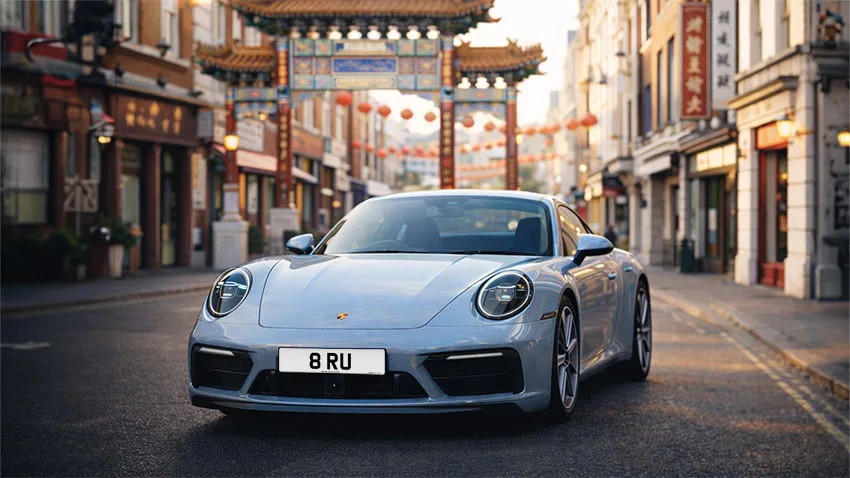 8 RU available today from Regtransfers
Numbers can be worth big money
While the world might like to think it is a more enlightened and less superstitious place in the 21st century, there is plenty of evidence to suggest that the idea of lucky numbers still has at least a tentative grip on our collective psyche. Who can honestly say they don't notice an approaching Friday the 13th?
Lucky numbers can be a valuable, tradeable commodity. Whether they occur in telephone numbers, car registration numbers, building or floor numbers or any of countless other contexts, people will pay good money for them, as we will see.
Lucky phone numbers
Businesses and wealthy individuals will pay large sums for certain telephone numbers, usually for numbers that are easy to remember, or numbers that are considered lucky.
-
In August 2020, a phone number ending in 88888 was sold at an auction in Beijing for ¥2.25 million yuan (approximately £247,000 at 2020's exchange rate). The number, which was one of a number of assets seized, and subsequently sold, by a Chinese court, attracted thousands of online bidders.
As repetition of auspicious numbers is believed to increase good fortune, a string of 8s should be very lucky. This does raise the apparent paradox of the previous owner being unlucky enough to have their assets seized.
-
In 2003, in an auction held in China's Sichuan Province, Sichuan Airlines bought a phone number for their customer service line. The price paid was approximately ¥2.3 million yuan (about £173,000 in 2003). Journalists later tested the number and found that it was indeed answered by Sichuan Airlines.
-
In another Chinese auction, the phone number 135-8585-8585 (which sounds like the phrase "let me be rich", or "be rich" repeated in Shanghai dialect) was bought for ¥9 million yuan (£611,000 in 2004) by a private individual. The bid was widely expected to prove spurious, but a manager for the vendor company later confirmed that the transaction had completed.
In other parts of Asia, purchasers have spent even larger sums on telephone numbers. A search result on the Guinness World Records website indicates that the most expensive mobile phone number is 666-6666, which was bought at a charity auction in May 2006. The anonymous winning bidder paid QAR 10 million (then £1.46 million) in the sale, which was hosted by Qatar Telecom in Doha. However, we can't find any reference to the number being bought for any supposed lucky qualities.
Building numbers
In China, and countries that are substantially influenced by Chinese culture, it is common for houses with the number eight (or repetition thereof) to cost more than comparable dwellings in the same neighbourhood. It is also common for buildings to charge a premium for floors whose numbers contain eight, especially when it is repeated.
The number 4 is often skipped when numbering houses and floors, just as the number 13 is sometimes omitted from apartment numbers or building floor numbers in Western countries.
Private number plates
Given the importance of lucky numbers, especially in Chinese culture, it may come as a surprise to learn that even though Hong Kong occupies seven places in our table of the world's top 50 most expensive number plates, only two of those seven plates contain the number 8. Hong Kong number plate 18, which achieved a price of HKD 16.5 million (£1.5 million) in a 2008 auction, is currently the world's 39th most expensive number plate. Hong Kong number 28 was sold in 2016 for HKD 18.1 million (£1.6 million), and currently occupies the 35th position in our rankings.
Hong Kong's two official languages are Chinese and English and culturally Hong Kong is influenced by both China and the west. The western aspect is partly a relic from the region's British colonial history, and partly the result of Hong Kong's status as an international business hub. The population is mostly Cantonese-speaking Han Chinese.
Even though spoken Cantonese and Mandarin are different enough that a speaker of one often cannot understand the other, the numbers eight and four, and the words for prosperity and death are phonetically similar in both languages, so the lucky/unlucky superstition regarding eight and four is as relevant to residents of Hong Kong as it is to residents of Beijing, where Mandarin is spoken.
Perhaps ironically, two of the best number 8 number plates (and the most expensive) were sold on the other side of Asia, in the United Arab Emirates. The Dubai number plate (BB) 88 sold for AED 14 million (£2.84 million) in 2025, taking 17th position in the most-expensive rankings. Dubai number (AA) 8 achieved AED 35 million (£7.5 million) in 2022, and is now the world's third most expensive number plate.
Lucky UK number plates
During our four decades in business, countless customers have told us that they chose their lucky number when selecting personal plates. In fact, lucky numbers and significant dates are two of the most common choices when it comes to deciding which digits one wants on a plate.
Unlike the famous Chinese lucky numbers, western lucky numbers are more of a personal thing. Ask 10 European or American people what their lucky numbers are and you will probably get close to 10 different answers.
If you're considering a new personal registration for the new year, why not consider including your lucky number in your choice? A bit of extra good fortune is always welcome!
And for our Chinese customers, Regtransfers has many registrations featuring the number 8, as well as multiple repeated number 8s!
Here are just a few.
- 168 GB
- 8 FJ
- 8 VG
- LCB 8
- 8 OGG
- 8 RHS
- CTK 8
- 8 EED
- BCP 8
- RTK 8
- 8 NBR
- 8 SBP
- 88 DB
- 88 PR
- 88 WR
- 88 FT
- 88 HSB
- 88 MAJ
- 88 SCM
- 88 MJA
- MDS 88
- 88 SPM
- LJM 88
- 88 SJT
- 88 MDS
- 88 DFC
- 88 GTH
- DSJ 88
- 88 AFP
- 88 DSF
- 88 CAA
- BSW 88
- 88 DGA
- DGL 88
- 88 GWJ
- 88 BWP
- LBF 88
- 888 ROY
- 888 SCM
- 888 JHR
- TJR 888
- 888 CVR
- 888 KLP
- 888 RKA
- 888 LPB
- RBW 888
- FKS 888
- RTF 888
- 888 NTB
- 888 GJF
- 8888 JA
Good luck with your personal plate quest!


