
The private plate market thrives
The broader economic outlook has felt increasingly fragile in recent years. Ongoing conflicts in Ukraine and Iran, persistent inflation and weakened consumer spending have all contributed to an atmosphere of financial uncertainty. Yet, despite these pressures, the private plate market continues to grow with quite remarkable resilience.
The industry continues not only to defy the wider economy but also to prosper. In fact, since 2014, the maximum spent on a private plate has increased by 79%, while the UK’s two most expensive plate purchases have both taken place within the last year alone.
This raises a question that financial explanations fail to answer completely: why are people willing to spend hundreds of thousands of pounds on a registration?
What is the consumer psychology behind private plates?
Economic analysis tends to frame private plates primarily as assets. The jargon is familiar: finite supply, increasing demand and long-term appreciation. While these are all certainly true, they do not fully explain the consumer psychology driving the market.
For most buyers, the motivation rarely begins with return on investment; it is typically sentiment that is the primary vehicle of a plate purchase. Buyers are usually searching for something entirely subjective: a name, a pair of initials or even a meaningful word. It’s that emotional attachment which, in turn, changes the way value is constructed.
Unlike traditional assets, where pricing is heavily influenced by market benchmarks and comparable sales, private plates exist in a far more subjective space. Their value is not purely determined by demand, but by how much a particular buyer and seller personally value a specific combination of characters. That distinction is an important one because sentiment doesn’t inevitably depreciate in the same way other financial assets do, like a car or a house.
In practice, owners who purchase a registration for emotional reasons are rarely eager to sell below what they originally paid, especially when the plate still carries that same personal significance years later. It is one of the few assets that has consistently delivered a reliable return on investment.
Scarcity creates a unique market
Part of what makes the market so prosperous is the extreme scarcity involved. Unlike a piece of real estate, a vehicle or even a tailored suit, there is only one plate. By platespeak standards (where numbers are used in place of letters), there is often only one or two legal sequences that deliver the closest possible version of a desired name or word. At the same time, the pool of interested buyers continues to grow, while the supply remains singular.
It is that imbalance between limited availability and rising demand that creates extraordinary upward pressure on pricing. A plate’s value is ultimately marked at the point where two subjective perceptions align: what one person is willing to accept and what another is willing to pay. It creates a marketplace that isn’t capped or at all contained by traditional valuation models.
The sales that demonstrate the evolution of the market
Recent record-breaking sales show just how broad and competitive the market has become and how demand is not limited to one category of plate. Complete word style registrations continue to attract significant attention. DEV 1L sold for £308,253 in 2021, while highly recognisable name plates such as KR15 HNA reached £233,360 in 2015.
At the very top end of the industry, despite the exceptional performance of the single-digit, single-letter 1 F, the most competitive category remains the two-letter number-one registrations. In fact, in just 2025 alone, several of these plates entered the list of the UK’s highest-ever sales:
1 F - £926,000
JB 1 - £608,600
DB 1 - £437,000
JK 1 - £336,000
JK 1 demonstrates a particularly dramatic appreciation from £209,300 in 2024 to £336,000 in 2025. This amounts to a staggering 61% increase in just under a year. Obviously, the plate itself hasn’t changed, but the market’s perception of its value has and quite strikingly so.
Why economic pressure may be reconstructing value
Inflation undoubtedly plays a role in the growth of the private plate market. As the costs of goods, services and assets rise across the economy, the psychological threshold for what constitutes an ‘expensive’ purchase also shifts. Essentially, purchases that once seemed excessive can begin to feel proportionate within an inflated economic landscape.
Though inflation alone doesn’t fully explain what is happening in the economy of private plates. The reality is that the rarest and most desirable are becoming increasingly difficult to acquire. Many of the most desirable plates, short and immediately recognisable, are already privately owned and often tightly held. When, or if, these plates do return to the market, competition becomes highly concentrated and often intense.
The continued growth of private plates is not driven by one factor alone, but by the convergence of three powerful forces: rising financial thresholds, invaluable sentiment and shrinking availability. Together, they have created a market that continues to break records, while many others struggle to maintain market momentum.
To follow the record-breakers as they happen, head over to the Private Number Plate Market Report we’ve added to our website. It provides key up-to-date insights into trends and value movements within the UK’s plate industry, serving as an intelligence hub to help buyers and sellers understand how the market is performing.
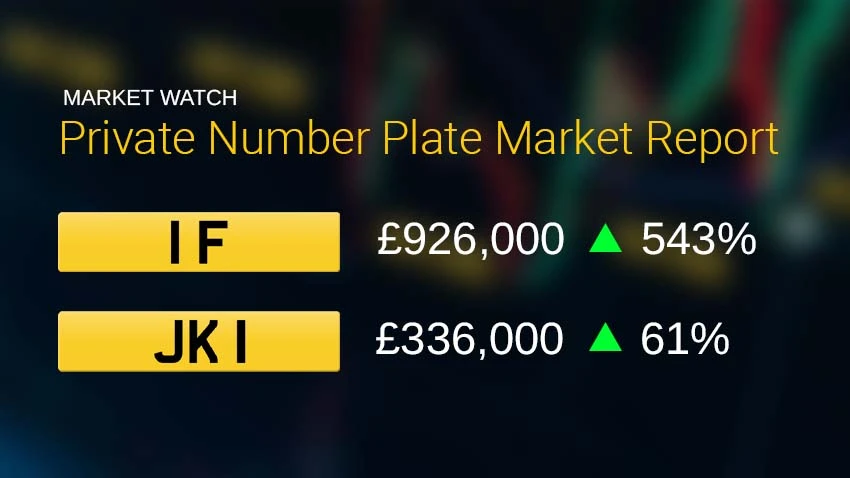
Private Number Plate Market Report
The market for private plates has seen unprecedented growth recently. Just as fine art or classic cars appreciate, registrations have become highly sought-after assets. In 2025 alone, the UK record for the most expensive plate was broken twice, proving that the demand remains at an all-time high.


