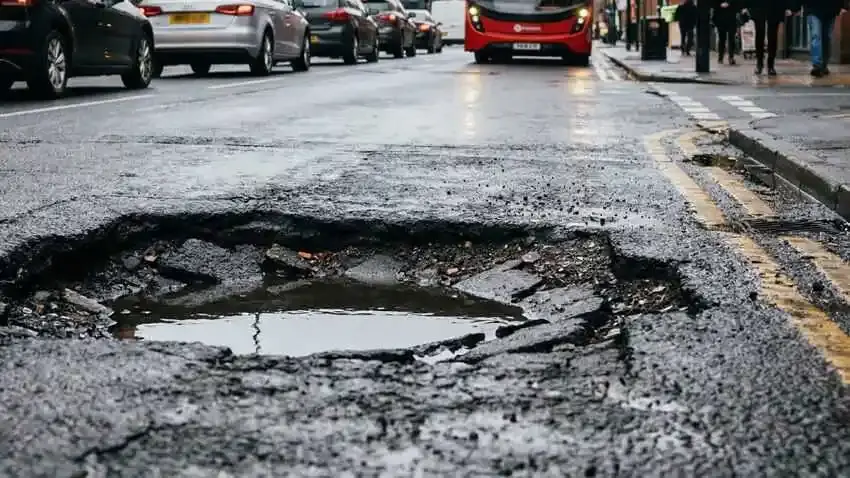
Still a growing problem
It's probably safe to say that almost every driver in the UK has had occasion to curse the state of our roads. Even the newest learning driver will, no doubt, have felt an unexpected bump as they pootled nervously around the suburbs.
The magnitude of the problem was, once again, highlighted recently by figures obtained via a Freedom of Information request submitted to 207 local authorities by the RAC.
The number of claims received by the 177 local authorities that responded with data increased by 91%, from 27,731 in 2021 to 53,015 in 2024. Furthermore, the majority of local authorities across England, Wales and Scotland rejected 90% of pothole damage compensation claims they received in 2024, and some councils rejected 99% of claims.
In January 2025, the BBC reported that the total cost of car repairs attributed to damage caused by potholes was £579 million in 2024. Let's just think about that for a moment: over half a billion pounds worth of damage was caused just by driving on the roads that are supposed to get us safely from one place to another.
Why so many?
As with most things, the causes are manifold and complex. At the core of the issue is an ageing infrastructure that has had to carry an increasing number of increasingly heavy vehicles. More and heavier HGVs drive our roads than decades ago when many of the road surfaces were laid. The popularity of SUVs and the advent of electric vehicles mean that the family car has also put on weight over the years.
In addition to the volume and weight of traffic on degrading surfaces, our roads are being subjected to more extreme weather conditions, including nearly 9% more rainfall than in the 1980s.
Rain and water run-off contribute to the erosion of surfaces. In winter, if rainwater has seeped into cracks and flaws in the road surface, it will expand if it freezes, often worsening existing wear and damage.
Failed repairs
In many localities, certain stretches of road have earned reputations for being particular pothole blackspots. It may seem that, no matter how many times road crews come out to repair potholes, the repaired holes either open up again within a few months, or are replaced by new holes in slightly different spots.
Clearly, in many cases where the surface is old and worn, the appearance of new holes should not be surprising, but repaired holes should last for years, so why aren't they? It seems like a reasonable and simple question to ask, doesn't it?
Nothing is ever simple
Of course, like most simple questions, that 'why' doesn't have one straightforward answer. Repairs may fail for many reasons, including the following:
- Unseen damage to the road substrate may undermine the repair. If the road's foundation is compromised, then so is anything laid on top of it.
- Many pothole repairs use materials and techniques that are designed to address an urgent problem temporarily, until a more lasting solution can be implemented. The "permanent" repair doesn't always happen.
- If the wrong materials and/or techniques are used, the repair will not last. A repair must be suitable for the location, the volume and nature of traffic and the conditions to which it is likely to be exposed.
- If the repair is carried out incorrectly, the repair will not last.
Types of repair
Repairs to small areas of road are known as patches and there are three main types of pothole repair:
- Cold patch repair. This is the classic quick, temporary fix. It uses pre-mixed asphalt that is packed into the hole. When compacted, it forms a hard, load-bearing surface.
- Hot patch repair. Hot patching is a considerably more durable method. It requires heating the asphalt, allowing it to bond with the existing surface. A hot patch repair should last for many years.
- Spray injection. This is the high-pressure application of an asphalt emulsion and aggregate. It is most suitable for small to medium-sized repairs.
Some local authorities seem to rely mostly on cold patching. Not only is this not considered to be permanent, it is also the type of repair most commonly carried out incorrectly. When done with the correct materials, equipment and techniques, cold patching may not be permanent (lasting as long as the surrounding road surface), but it can still perform well for many years.
Temporary repairs done right
You may have seen pothole repairs that look like someone has just poured a pile of chunky black stuff into the hole and walked off. Unfortunately, in some cases, that is literally what happened. Some local authorities have even posted social media photos, apparently proud of 'repairs' that look like little asphalt molehills
A correctly executed, durable patch will be neat and flush with the surrounding road surface. It will have been done as follows.
- The edges of the hole will have been cut to give a neat, clearly defined area to repair.
- Loose material will have been removed from the hole
- Unless the chosen repair material is water-activated, workers will ensure that the hole is free of standing water.
- A bonding agent may be applied to all or part of the hole.
- The correct pre-mixed asphalt will be poured into the hole.
- The repair material will be tightly compacted, ensuring that it is evenly distributed, that it fills the entire volume of the hole without voids, and that the resulting surface is flat. Ideally, a compacting machine or 'whacker' will be used.
- A tarmac sealant, and/or bitumen tape that is heated to make it bond with the repair material and the road surface, will be used to seal the edges of the repair against water ingress and consequent damage from the freeze-thaw cycle
Demanding quality
As the problem has worsened, public awareness and anger has grown accordingly. Members of the public have resorted to using spray paint to mark potholes, and to buying premixed asphalt and carrying out DIY repairs. People have also taken to the internet to exert pressure on their councils and contractors to do a better job. There are Facebook groups and YouTube videos dedicated to informing people and prompting drivers to complain about potholes and about shoddy repairs.
Another way to exert pressure to do better is to ensure that drivers press claims if their cars suffer damage due to potholes. In an earlier article, we explained how to make a claim for pothole damage to your car but, bearing in mind the high proportion of refused claims, tenacity may be required to claim successfully.
If simply saying 'no' is enough to relieve the pressure, then we must refuse to take no for an answer. We must appeal refusal of claims, consider private court actions, complain to our MPs and directly to the Department for Transport. As the appropriate metaphor says, it's the squeaky wheel that gets the oil. We must squeak louder.
Notes
- Rainfall increase reported by Dr James Carruthers of Newcastle University, quoted in press release entitled, 'UK winters become wetter as greenhouse gases rise'. Published 11 February 2026.


