Initial market reaction
Ferrari has entered the EV market with its first all-electric car, and the market hates it. The initial reaction from investors saw £4 billion wiped from the value of Ferrari's stock.
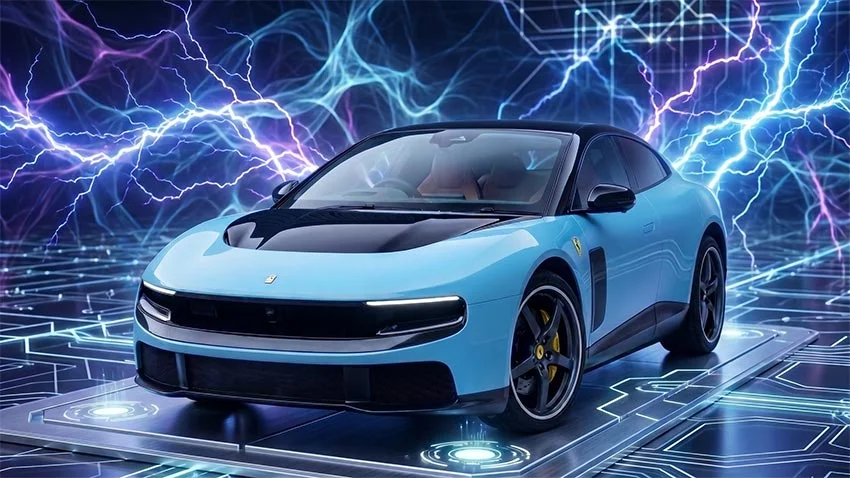
An electric vehicle from the world's most famous purveyor of stylish, roaring sports cars was always going to face a challenging reception, but hostility to Ferrari's Luce is not simply from petrolheads in denial about the need for change, but from the length and breadth of the motoring community. EV-sceptics and green motoring devotees are united in their dislike of the Luce. The problem isn't political, ecological or ideological: the car simply doesn't look like a Ferrari.
The specs
Setting aesthetic considerations aside for a moment, for an electric vehicle, the Ferrari Luce's vital statistics would be the envy of many petrol-driven sports car owners.
1,050 horses worth of power, will push the car to a top speed of 192mph. The Luce will accelerate from 0 to 62mph in 2.5 seconds, and from 0 to 124mph in 6.8 seconds. It is powered by a 122kWh battery which is expected to deliver a range of around 330 miles.
The body design is where the involvement of designers Jony Ive and Marc Newson is most evident. The Luce's design is the fruit of a five-year collaboration between Ferrari's in-house team and Ive and Newson's LoveFrom studio.
One of the most striking features is the amount of glass in the cabin area. The car has large, curved windscreens and a panoramic glass sunroof. Another aspect that is unique in the history of Ferrari cars is that the Luce has five seats.
The car has been designed for maximum aerodynamic performance, and it is claimed that it has the lowest drag coefficient (0.254) of any Ferrari road car made to date. Active suspension will lower the front of the car by 10 millimetres when cruising to further reduce drag. The large windscreen wipers are placed vertically, along the sides of the windscreen, to reduce their effect on airflow over the car. The glass in the cabin windows and sunroof is curved in such a way as to contribute to the aerodynamic efficiency.
And the Luce's price tag in the UK? Around £450,000.
The criticism
The car's design has been widely praised by those who understand such things. From a performance and practicality point of view, the Luce should be a winner: the figures are impressive, as we've seen.
Visually, the car is unusual, but few have called it objectively ugly. With almost any other badge on the bonnet (and a correspondingly reduced price), the Luce would probably have received quite a warm welcome. Indeed, Ferrari itself has produced limited numbers of much odder and uglier cars. Check out the one-off Ferrari Conciso, a car that Topgear.com described as a "cross-eyed roller skate", or the Ferrari 330GT 2+2 Navarro, another one-off that looks like the illegitimate issue of a DeLorean and a cardboard box.
The problem for many seems to be, as we said above, that the Luce doesn't look like a Ferrari. The specs shout "performance car"; the design mumbles "sportyish family saloon".
Does it deliver?
That depends on what you want it to deliver. If you want to drive something that won't choke children or warm the world with its exhaust emissions, and if you're satisfied with innovation, comfort, speed, excellent road-holding, maximum range per charge, and room for five people, then, yes, the Luce is a real option if you can afford it.
If you would pay the better part of half a million quid, but only for a green choice that maintained classic Ferrari design features, was saturated with street cred, and would attract the envious glances to which a bank-breaking supercar should be entitled, then Ferrari's Luce is not the car for you.
People aren't excited by family cars in the same way they are by Maseratis, Bugattis, Lamborghinis and Ferraris. If people aren't excited, why would they pay a fortune when they can buy something from Nissan that looks kind of similar and which would leave them still able to afford a roof over their heads?


