Header graphic Rolling Stones inset: London Records, Rolling Stones 1965, marked as public domain, more details on Wikimedia Commons
We already wrote about the cars and number plates owned by the members of The Beatles, arguably the 20th century's most famous and innovative pop/rock group. During the 1960s, there was another band who were frequently depicted as rivals to The Beatles, even though their image and musical style were very different: that group was The Rolling Stones. In fact, that group still is The Rolling Stones.
The rivalry
The Beatles may have won the perceived battle in terms of fame and leaving a culturally important legacy, but The Stones are still performing today, whereas The Beatles, as a band, disintegrated in 1970.
Another key difference between The Stones and The Beatles was image. The Beatles were, for the most part, cheeky but kind of respectable for pop stars. When looking for scandal and controversy, The Beatles wouldn't be the first group a journalist would look at.
When comparing the two bands, The Rolling Stones were the bad boys. The American influence, particularly that of the rhythm and blues music of black American artists, remained strong in The Stones' music long after The Beatles had evolved into a far more unashamedly British kind of group.
The Blues
The famous Rolling Stones record 'Little Red Rooster' is actually a version of the blues song 'The Red Rooster', written by Willie Dixon and recorded by Howlin' Wolf. Wolf, real name Chester Burnett, and Dixon were two of African American blues music's most well-known songwriters and performers. Despite their contribution to the evolution of rock and roll, the trailblazing older generation of bluesmen were strangers to mainstream television and largely unknown to young people in the 1960s. The Rolling Stones helped change that when they appeared on the US television show Shindig in 1965. The Stones insisted that Howlin' Wolf appear on the same show as he was, in guitarist Brian Jones' words, one of their biggest idols. Wolf duly performed on the show. Amongst the musicians backing his performance was a young piano player named Billy Preston. Preston would later become a well-respected session player working with The Beatles and achieving significant fame in his own right. Rolling Stones drummer Charlie Watts, bass player Bill Wyman, and road manager and former pianist Ian Stewart met with Howlin' Wolf again when he visited London in 1970. Along with guitarist Eric Clapton and Spencer Davis Group singer and multi-instrumentalist Steve Winwood, they contributed to an impromptu blues supergroup, recording a number of sessions that would be released as an album the following year.
The lifestyle
Having demonstrated their respect for the older artists who had inspired them, the Stones seemed to feel that their next duty was to fully embrace the stereotypical rock and roll lifestyle, which they did with far more abandon than their Liverpudlian rivals. Even when The Beatles did indulge themselves, they tended to receive less aggressive media coverage than the London group. The newspapers often ran sensationalist Rolling Stones stories relating tales of sex, drugs and rock and roll.
In 1967, police raided a party at a house owned by guitarist Keith Richards and found drugs in the property. Richards, vocalist Mick Jagger, and several of their famous friends were arrested, and a high-profile trial ensued. It took a public campaign and unexpected support from the very conservative editor of The Times, William Rees-Mogg, to have Keith Richards' conviction overturned and Jagger's punishment downgraded from a custodial sentence to a conditional discharge.
Another famous story, confirmed by Keith Richards in his autobiography, tells of an episode in which an intoxicated Jagger phoned Charlie Watts' Amsterdam hotel room one night, demanding to know "Where's my drummer?". Charlie dressed himself in his customary Savile Row suit, marched to Jagger's room and knocked on the door. When the door opened, Watts strode in and delivered a solid right hook that knocked Jagger down. The punch was reportedly accompanied by the words, "I'm not your drummer: you're my singer".
The cars
With celebrity in any field - entertainment, sport, business - it is almost a given that impressive cars will soon follow. With rock and roll musicians, those cars are often associated with wild tales of recklessness and excess.
Beatle George Harrison was involved in a number of car accidents, the most famous being the crash of his white Mercedes in 1972, in which George and his then wife, Pattie Boyd were both injured. The same year, Harrison's friend, guitarist Eric Clapton crashed his brand new Ferrari 365 GT4 BB. Clapton had driven less than 50 miles in the car at the time of the accident.
The Rolling Stones have a similarly chequered history with their vehicles. Stones guitarist Keith Richards seems to specialise in accidents involving luxury vehicles: in 1969, he crashed his Mercedes in Sussex, and in 1976 he fell asleep at the wheel of a Bentley. In the latter incident, Richards and wife Anita Pallenberg survived - a fact that Richards attributed to the sturdiness of the vehicle. One can't help but suspect that Bentley may have preferred a less dramatic testimonial.
Mick Jagger
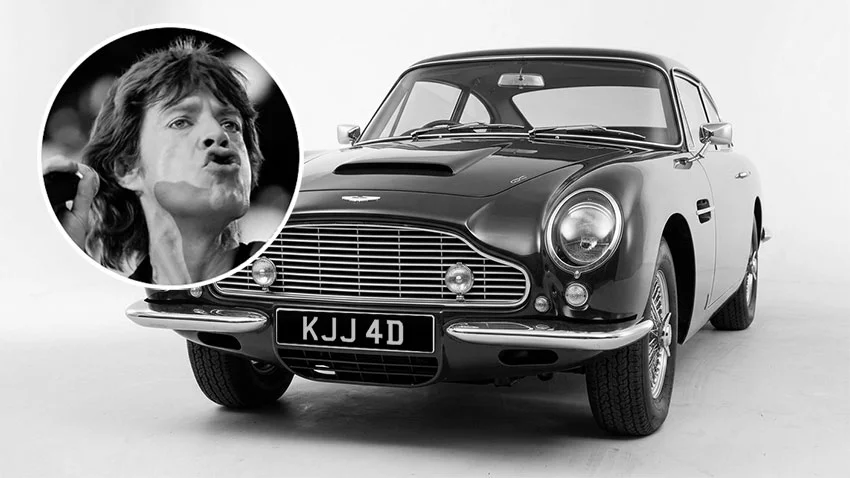
Mick Jagger inset: Marcel Antonisse / Anefo, Mick Jagger (1982), CC0 1.0
After leaving school, the Stones' Kent-born frontman, Mick Jagger, studied finance and accounting at the London School of Economics. That path soon took a rather drastic diversion and Mick found himself singing for Alexis Korner's rather chaotic band, Blues Incorporated. Jagger and his friend Keith Richards joined the band, which also contained guitarist Brian Jones and drummer Charlie Watts. When Jones left Blues Incorporated and, in 1962, advertised for musicians to form a new group, Jagger and Richards answered the ad, and the group that would become The Rolling Stones began to take shape. Bassist Bill Wyman joined later the same year and drummer Charlie Watts followed in 1963.
While not what most people would consider a technically impressive singer, Jagger has a distinctive voice and an overwhelmingly confident stage persona. He has lived an almost stereotypical life of sex, drugs and rock and roll, and ticks almost every requirement of the pop culture icon job description, and then some. He has been arrested and convicted for possession of drugs, taken part in street protests, been photographed by famous photographers, painted by famous artists, knighted by famous monarchs and had extinct arthropods named after him.
1966 Aston Martin DB6
Singer and frontman Mick Jagger is a lifelong car fanatic. One of his first notable vehicle purchases was a brand new, 1966 Midnight Blue Aston Martin DB6. The car was registered with the number plate KJJ 4D (D being the year suffix letter for 1966). Jagger posed with the car for a series of photographs taken by British photographer Gered Mankowitz. Confusingly, while sources all agree that the car later suffered accident damage, they disagree about whether the damage was sustained in one accident or two. There are reports of a collision with a Ford Anglia, supposedly driven by the Countess of Carlisle, and of a collision with a Kraft food delivery truck. Both incidents are supposed to have occurred near Jagger's London flat. It has become unclear whether this was actually two explanations (one apocryphal) for the same accident or whether there were, indeed, two accidents. Accounts for both alleged incidents describe damage to the rear, passenger-side door and rear wing. The only photographs we have been able to find of the incident(s) show Mick talking to a police motorcycle officer beside the dented Aston Martin. There is no sign of the other vehicle involved, so the real details of what happened remain something of a mystery.
1964 Ford Galaxie 500XL convertible
As well as iconic British cars, Jagger is a fan of North American automobiles. One of his most famous vehicle acquisitions was his 1964 Ford Galaxie 500XL convertible. This particular Galaxie was an exceptionally rare factory right-hand-drive model.
Credible reports by a subsequent owner who had the car's original UK documentation state that the Canadian-made car was imported to the UK in 1964 by a London hotelier, and that Jagger purchased it in 1978. Photographs and video of the Ford's registration document in Jagger's name show the registration number as AYP 2B.
Mick kept the Galaxie for a few years before selling it on and it has changed hands several times since. A YouTube video posted in May 2024 shows the Galaxie, previously owned by Jagger, being shown off by its owner at the time the video was shot. The car appeared to be in great running condition, still together with its documents, original equipment and number plates. It had been repainted some years before, but otherwise appeared to be in excellent factory condition.
1964 Rolls-Royce Silver Cloud III
Mick wasn't the only Stone to own one of these classics; guitarist Brian Jones also owned a Silver Cloud, although in Brian's case it was a mk II.
1969 Jaguar 4.2 XKE / E-Type
A 1960s legend, the E-Type Jaguar won almost universal acclaim. It was an obvious choice for Mick Jagger and one that suited his image perfectly. Mick reportedly gave the car to a studio musician in the USA. In the 1980s, Jagger also made an attempt to buy a D-Type Jaguar, but was outbid at auction.
1967 Austin Mini Cooper S
Something of a sheep in sheep's clothing compared to the E-Type Jag, but the Mini was another great favourite amongst Britain's 1960s pop stars and models. The Beatles famously all owned Minis, and Mick purchased his from a dealership owned by Beatles manager Brian Epstein. Jagger sent the car to Wood & Picket Ltd for tweaking to suit his preference.
Photographs of the Mini featuring Mick and his girlfriend, singer and actress Marianne Faithfull, abound on the internet, but we have been unable to find any images showing both Jagger and the car's number plate. However, it is widely reported, and rarely disputed, that the registration was OGO 668E.
1969 Morgan Plus 8 Roadster
Despite being a British company until 2019, when a majority stake was bought by an Italian investment company, Morgan's biggest market in the 1960s was the USA. Despite selling most of its output overseas for some of its history, Morgan remains an iconic manufacturer of sports cars in a classic British style. It's a style for those who want speed and power to come with elegance and personality - something arguably missing in many contemporary supercars.
Mick Jagger's choice of the Plus 8 was a wise one. The 1930s-styled model is one of Morgan's most famous cars, and is reputed to have saved the company when prospects looked bleak. Jagger used his in Saint-Tropez when he married Bianca (formerly Blanca) Pérez-Mora Macías in 1971.
1983 Ferrari 400i
This one is notable as the Ferrari 400i is not regarded as one of the brand's most desirable models (possibly an understatement). The 400i, with its 4-litre V12 engine, was, nevertheless, very popular with The Rolling Stones - so much so that three members of the band bought them. In total, seven of this model were purchased by the Stones for use by the band and staff.
Mick's came finished in metallic blue, with an automatic gearbox. There appear to be very few pictures of Jagger's 400i, so we're not sure what its registration number was at the time he owned it.
1984 Ferrari 288 GTO
When Mick bought the Ferrari 288 GTO, there was no question about whether or not he had chosen a good Ferrari or a "bad" Ferrari (is there really such a thing?). For a period, the 288 GTO was the fastest production car in the world. What rock and roller could resist such a label?
The GTO has been described as "menacing" by TopGear.com and as "angry" by Italian racing driver Michele Alboreto. Clearly not a car to be taken lightly, and Jagger evidently took it very seriously, as he held on to it for some years. A rare and awesome car.
Mercedes-Benz 300 SEL
Mercedes-Benz is another brand Jagger has purchased more than once. Of the several that he has owned, the 300 SEL 6.3 is notable for being a model also owned by George Harrison. In fact, Harrison's 300 SEL was the car he crashed in the accident we mentioned earlier in the article. Other Mercedes-Benz models owned by Jagger include a 1990 560 SEL V126 and a 2013 S 550.
However, Mick is not all about luxury saloons and supercars. He has owned at least one Land Rover Defender (the real Land Rover) and a couple of BMW motorcycles.
Keith Richards
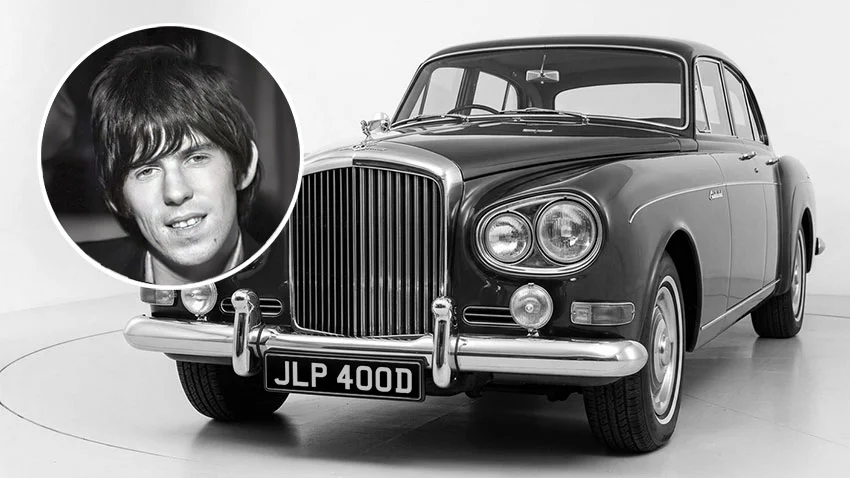
Keith Richards inset: Olavi Kaskisuo / Lehtikuva, Keith Richards (1965), marked as public domain, more details on Wikimedia Commons
Known as "Keef", Richards is the band's sole remaining original guitarist. The Stones have had two successive co-guitarists (Mick Taylor, followed by current member Ronnie Wood) to keep Richards company since the death of fellow original guitarist Brian Jones in 1969 but, despite odds stacked against him by an extreme rock and roll lifestyle over the years, Richards is still going. Keith and Mick Jagger, often collectively credited as The Glimmer Twins, have written most of the Rolling Stones' original songs.
1965 Bentley S3 Continental Flying Spur
We have already mentioned a couple of Keith Richards' cars in passing: the first is Keith Richards' 1965 Bentley S3 Continental Flying Spur, with the registration JLP 400D,which he purchased new in 1966 and then crashed when he fell asleep at the wheel in 1976. The Bentley is possibly the car with which Keef is most often associated. The guitarist named his Bentley Blue Lena, as a tribute to jazz singer Lena Horne, and definitely made it his own with a unique modification. Richards' Bentley had a secret compartment, specifically for hiding drugs.
Despite the accident in 1976, Keith Richards' S3 Continental Flying Spur was fully repaired and restored to its former glory. Keith eventually sold the car in 1978. It subsequently changed hands a number of times and was auctioned by Bonhams in 2015. The price? Three-quarters of a million pounds.
1983 Ferrari 400i
When discussing Mick Jagger's cars earlier, we also briefly alluded to the Ferrari 400i, the model that was bought by three of the band's members. Of the cars ordered by the band, Keith's was the only one supplied with a five-speed manual gearbox.
When Sotheby's sold the car for Keef in 2017, at which time the car had just 3,627 km on the clock. The valuation was up to £160,000. When the auction took place at Ferrari’s headquarters in Modena, Italy, as part of the “Ferrari Leggenda e Passione” event on 9 September 2017, it actually sold for €345,000 - that would be £298,797 in today's sterling.
1972 Ferrari Dino 246GT
This model, named after Enzo Ferrari’s favourite son, is among the most coveted cars of the 1970s. Unlike his 400i, Keith's Dino, registration number GYL 157N, clocked up 25,000 miles while in his care. Richards sold the car in 1986. In its later life, Keith's old Dino was acquired by Liam Howlett, founder of The Prodigy, purveyors of a somewhat different style of music from that made by The Stones.
1950 Pontiac Chieftain ‘Silver Streak’ Convertible
This Pontiac model was named “Silver Streak” thanks to its chrome hood strips. The example owned by Richards was purchased second-hand in 1971, during the guitarist's tax exile period in Villefranche-sur-Mer, south-east France.
Bill Wyman
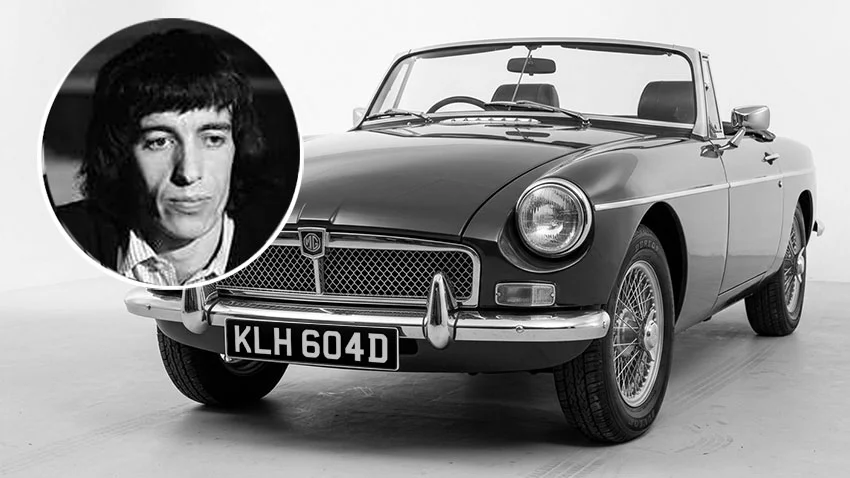
Bill Wyman inset: Olavi Kaskisuo / Lehtikuva, Bill-Wyman-1965, marked as public domain, more details on Wikimedia Commons
Like his erstwhile bandmates, former bass player and oldest member Bill Wyman has loved his cars. Wyman officially left The Stones in January 1993. While other members, and long-serving sideman Darry Jones, have played bass for the band, Wyman has never been replaced as the band's official bass player. He continues to work in music today, albeit rather more sedately than he did during his years with The Rolling Stones.
1964 MGB
Less flashy than many of the cars driven by his fellow Stones, and by Bill himself, the sporty, two-door MGB is no less iconic. A 1966 photograph taken by Gered Mankowitz shows Wyman sitting on the driver's side front wing of his MGB. The number plate on the car is clearly readable as KLH 604D.
1966 Mercedes-Benz 250 S
Wyman's first Mercedes was certainly not his last. Bill Wyman asked for tinted windows on his car and, as Mercedes had never supplied curved tinted windows before, Wyman gamely dished out £350 of his own money to help cover the development of the option. The car's registration number was KYM 585D.
Although Wyman sold the 250S a few years later, he missed the car and bought it back from its owner at the time, reputedly an an elderly woman who asked Wyman to pay the £1,000 price in £1 notes. The car was in poor condition when Wyman retrieved it. Restoring it cost him another £20,000.
1983 Ferrari 400i
Yes, Bill Wyman completed the trio of Stones members who ordered Ferrari 400i models. As we've already discussed this model and its spotty reputation when writing about Mick and Keith, we'll say no more about it.
1971 Citroën SM
Mention of Citroën may not have immediately got your blood pumping - unless you're an avid fan of 1960s French taxis or of the serviceable, but easily mocked, 2CV. However, there has always been more to the French brand than just the iconic but quirky DS and 2CV.
Bill Wyman's Citroën SM was powered by a 170 horsepower V6 Maserati engine that could push the car to 140 miles per hour. At the time, the SM - originally intended to be a sports version of the popular DS - was the fastest front-wheel-drive production car in the world. The Citroën SM, originally registered with the French number 958 RU 06, was delivered to Wyman at his home in the South of France while The Rolling Stones were recording the album 'Exile On Main St'. Wyman later brought the car to the UK and reregistered it as HGC 226J.
Charlie Watts
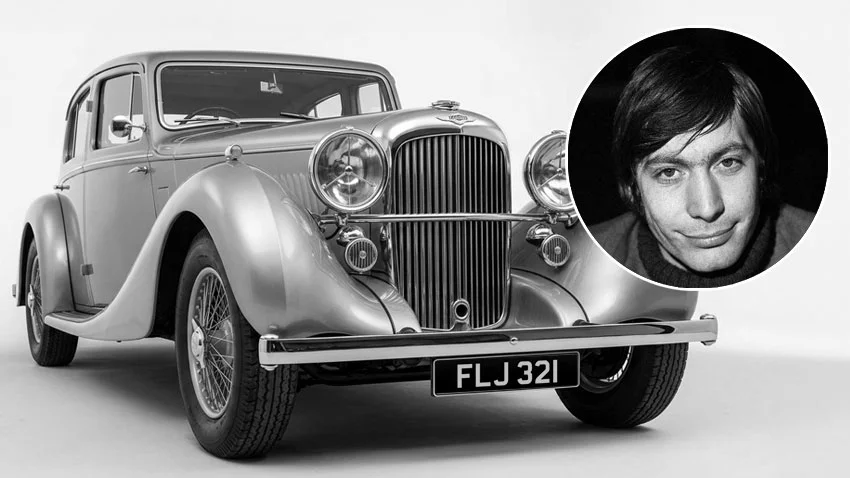
Charlie Watts inset: Olavi Kaskisuo / Lehtikuva, Charle-Watts-1965 (cropped), marked as public domain, more details on Wikimedia Commons
Charlie Watts was The Rolling Stones drummer for 58 years, from 1963 until his death in 2021, when he was 80 years old.
Despite being the musical foundation of a group sometimes called the best rock and roll band in the world, Charlie Watts had a rather ambivalent attitude towards his life as a working musician. While he loved playing with The Stones, Charlie resented the time taken up by touring, and had no real interest in being a pop star, or in all the fan adulation that came with the role. So far as adoring female fans were concerned, Charlie Watts must have seemed to be both a challenge and a disappointment. He married Shirley in 1964 and the couple remained married for 57 years until Charlie died. While on the road with the band, Charlie remained faithful to Shirley, consistently declining the close companionship of other women who approached him.
Aside from his career as a highly respected drummer, Charlie was famous for his dapper appearance. He was a habitual wearer of Savile Row suits and often named as one of the World's Best Dressed Men. In 2006, the pop culture and fashion magazine Vanity Fair elected Watts into its International Best Dressed Hall of Fame list.
It has been reported, correctly, so far as we can ascertain, that Watts had a suit made to match each of his cars. He certainly loved his cars but, paradoxically, Charlie himself never held a driving licence. His interest in automobiles was purely cultural and aesthetic.
1937 Lagonda LG6 Rapide
Charlie bought the V12-engined Lagonda in 1983 bearing its original registration FLJ 321. The car was one of only 25 ever made. With a top speed of 105 mph, the LG6 Rapide was one of very few pre-World War II cars able to exceed 100mph.
I don’t particularly want to drive, but I buy vintage cars just to look at them, because they’re beautiful.
Details of Charlie Watt's other cars are not as easy to track down as those of the other Stones, but it is generally accepted that his collection included a Bugatti Type 57 Atlantic, a yellow Lamborghini Miura S and ... Wait for it... A Citroën 2CV, also in yellow, identical to the car driven by Roger Moore in the Bond film For Your Eyes Only.
Brian Jones
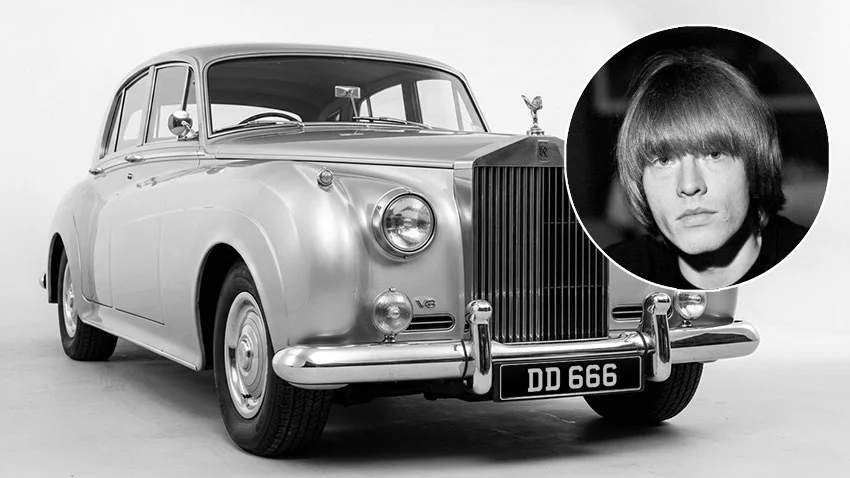
Brian Jones inset: Olavi Kaskisuo / Lehtikuva, Brian-Jones-1965, marked as public domain, more details on Wikimedia Commons
Brian Jones died tragically young in 1969. He is considered by many to be a member of "the 27 Club", a kind of urban myth that suggests that there is significance to the fact that many pop culture icons passed away at that age, including Jones and musicians Jimi Hendrix, Janis Joplin, Jim Morrison (The Doors), Kurt Cobain (Nirvana) and Amy Winehouse. Over time, Brian Jones found his influence and control over The Rolling Stones to be diminished as management and his fellow Stones had ambitions that differed from his. Friction existed within the band, due to Brian's frustration and his various additional issues, which included increasing unreliability due to drink and drugs, and his inability to get a US visa for the purposes of touring, due to his drug convictions. In June 1969, Brian Jones was effectively dismissed from the band he had founded. In early July 1969, Brian was found unresponsive in the swimming pool of his house. By the time medical assistance arrived, he was found to be deceased. The cause of death given by the coroner was drowning. The circumstances of Jones's passing were ruled to be death by misadventure.
Despite his tragic end, while he was alive, Brian enjoyed the trappings of his fame, including his car.
1959 Rolls-Royce Silver Cloud II
As Jones's lifestyle often left him unable to drive, he chose to avail himself of the services of a chauffeur. Nevertheless, Brian still managed to get himself and the car, with its original DD 666 registration, into the occasional spot of bother.
Rom Keylock, the band's security man, chauffeur, and general fixer (called Mr Get-It-Together by Keith Richards) once described a thoroughly wasted Brian's attempt to drive the Rolls through a hotel's revolving door in order to get at Bob Dylan, with whom Brian and Keith Richards had earlier had a rather heated difference of opinion.
Ronnie Wood
Ronnie Wood found increased fame with the Stones but, when he joined the band in 1975, he was already well-known as a member of The Faces and of The Jeff Beck Group. Ronnie was made a full member of The Rolling Stones in 1976 in his capacity as a musician, but he was a salaried member rather than a full partner for many years. That changed around the time Bill Wyman left, and Ronnie is now a full member in both musical and business terms.
1969 Lotus Seven S3
One of Ronnie's best-known cars was also one of his earliest. The Lotus Seven was designed by Lotus founder Colin Chapman, and found fame when it was featured in the cult 1960s TV show The Prisoner.
Ronnie's automotive preferences subsequently leaned more towards luxury than sporty styling, and he has owned a number of Rolls-Royce and Bentley models.
2017 Rolls-Royce Wraith "Inspired by British Music"
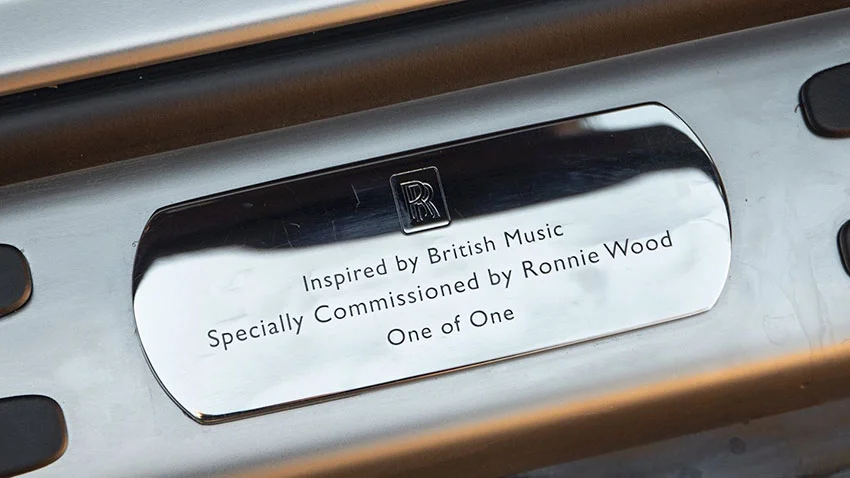
This is something of a unique entry in this survey of The Rolling Stones' cars. It is not a car owned by Ronnie Wood, but rather one that he had a hand in creating.
In 2017, Rolls-Royce announced a limited series of one-off Wraiths entitled "Inspired by British Music". Each of the nine cars was customised in collaboration with an important figure from the world of British music. Those invited collaborators included Roger Daltry of The Who, Ray Davies of The Kinks, Shirley Bassey, Francis Rossi of Status Quo, Nick Mason of Pink Floyd, Giles Martin, son of songwriter and producer the late Sir George Martin, and Ronnie Wood of The Rolling Stones.
In addition to the Wraith's standard features and options, the Ronnie Wood Rolls-Royce also features:
- Artwork by Ronnie on the centre "waterfall" between the rear seat
- Ronnie Wood Signature Embroidered Front Headrests
- Ronnie Wood "I Feel Like Playing" Polished Stainless Steel Tread Plates
- Ronnie Wood Embroidered Rear Centre Leather Waterfall
- Ronnie Wood Lyrics Engraved on Copper Door Flights
- Ronnie Wood Engraved Spirit of Ecstasy Base
- Union Jack Engraved C-Pillars
The "I feel Like Playing" aspect of the Ronnie Wood theme for the car is a reference to Ronnie's seventh solo studio album, I Feel Like Playing', which featured many famous guest musicians, including Slash, Billy Gibbons, Flea and Bobby Womack.
The photo is courtesy of Romans International, who currently have one of these nine examples available for sale.
Too late to stop now
The Rolling Stones latest single, 'In the Stars' recently topped the UK's Official Vinyl Singles and Official Physical Singles charts, and their 25th album, Foreign Tongues, is released on July 10, 2026. After 64 years, it feels as if they may never stop.
It seems extraordinary that so many of the original members have not only survived but are still performing. 82-year-old Keith Richards', especially, is the subject of many jokes about his apparent immortality, despite a lifestyle that would have (and has) killed many rock stars.
We'll leave you with a couple of the best-known Keef gags.
When God created people, Adam and Eve pointed to Richards and asked God who he was. God replied, "Oh, that's Keith. He was already here when I arrived".
Young people have to start thinking about the sort of world they want to leave for Keith Richards when they die.

JAG 63R is available exclusively through Regtransfers.


