This page describes the rules governing the display of physical number plates for motorcycles and tricycles.
NB: This is a companion piece to our article on the car number plates display regulations.
Motorcycle number plate fonts and spacing
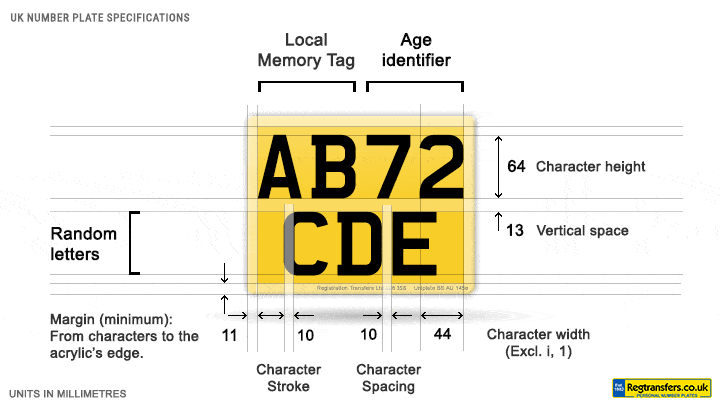
Motorcycle number plates are governed by a slightly different set of rules from those that apply to ordinary plates. The basic physical properties of the plates, such as material and reflectiveness, are the same for cars and motorbikes but the sizes of plates for bikes, and the size and spacing of characters, are more compact in keeping with the smaller size of the vehicle. Additionally, motorbikes and scooters registered after 1st September 2001 must only display rear number plates: they are not allowed to have front plates.
Many people, especially road safety groups, consider this a significant improvement, as older motorbikes often had metal front plates mounted on top of the front-wheel mudguard. These plates were designed to be read from the side and their blade-like nature meant that their front-facing edge presented a risk of laceration to pedestrians should collisions occur.
Motorcycles registered before 1st September 2001 are allowed to display a number plate at the front but they do not have to.
The layout specifications for motorbike and scooter number plates are as follows:
- characters must be set out over two lines
- characters must be 64mm tall
- characters (except the number 1 or letter I) must be 44mm wide
- the character stroke (the thickness of the black print) must be 10mm
- the space between characters must be 10mm
- the space between the age identifier and the random letters must be 30mm
- the margins at the top, bottom and side of the plate must be at least 11mm
- vertical space between the age identifier and the random numbers must be 13mm.
Motor tricycle plates
Tricycles of construction based upon motorcycle frames and bodies must comply with the rules for motorbike number plates as set out above. Trikes that have been constructed based upon four-wheel vehicle bodies such as cars may display either car plates, as described in our main guide to plate rules and regulations, or plates that meet the motorbike rules above.
Quad bike plates
Quadricycles and quad bikes must have both front and rear number plates if they are to be used on the road. Larger quads must display car-type number plates. On the other hand, smaller quads - those with engine power of up to 15 kilowatts and a weight of up to 400 kilograms - can display motorcycle-type plates as described above.

Frequently asked questions
The characters on a motorbike number plate must be 64mm tall and 44mm wide (except the number 1 and letter I), with a 10mm stroke thickness and 10mm gaps between characters. Characters are set out over two lines, and the plate needs margins of at least 11mm at the top, bottom and sides. See our number plate rules for the car plate equivalents.
No. Motorbikes and scooters registered on or after 1 September 2001 must only display a rear number plate, so front plates aren't allowed on these newer bikes. Motorcycles registered before that date can still display a front plate, but they don't have to. The rule exists partly for road safety, since older metal front plates could injure pedestrians in a collision.
Yes, you can put a private or personalised registration on a motorbike in exactly the same way as a car, by transferring the registration through DVLA. The physical plate itself still has to meet motorcycle-specific size and spacing rules, so you can't just fit a car-sized acrylic plate to a bike.
Yes, a registration number itself can be transferred from a car to a motorbike or the other way round, using DVLA's standard transfer process. What changes is the physical plate: you'll need a new plate made to the correct size and spacing rules for whichever vehicle the registration is moving to.
No, you can't simply shrink a number plate to make it fit more neatly on a motorbike. Motorcycle plates must have margins of at least 11mm at the top, bottom and sides, and characters must stay at the specified 64mm by 44mm. Driving with an incorrectly displayed number plate can lead to a fine of up to £1,000 and an MOT failure.
Quad bikes and quadricycles used on the road must display both front and rear number plates. Larger quads use car-style plates, while smaller ones, with an engine power of up to 15 kilowatts and an unladen weight of up to 400 kilograms, can use motorcycle-style plates instead. Tricycles built on a motorbike frame follow the motorcycle rules above. Trikes built on a car-type body can use car-style plates or the motorcycle rules.
Yes. Every motorcycle plate Regtransfers supplies is made to British Standard BS AU 145e, using the legal character sizes and spacing for motorbikes. We supply acrylic plates when you buy a private registration from us.
Yes. Regtransfers can supply raised 3D characters, often called 4D plates, for your motorbike. They're made to British Standard BS AU 145e and the legal motorcycle size and spacing rules, and you can choose them when you buy a private registration from us.
Share this...