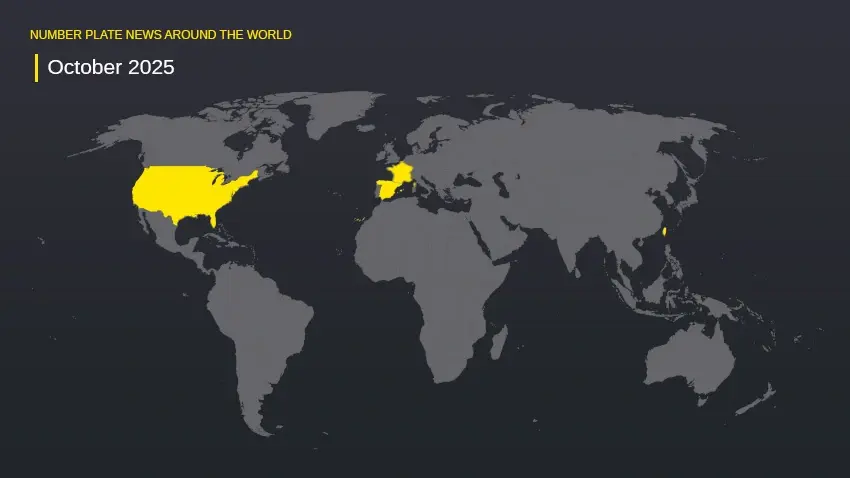
USA: Police not impressed by artistic licence plate
Officers of the California Highway Patrol showed no appreciation for the handiwork of a driver who had made his own car licence plates.
A social media post made later by the CHP department did acknowledge the driver's "creativity", but that probably didn't do much to soften the blow of a $197 fine.
The post said that an officer stopped the suspect vehicle because they had noticed “something unusual” about the car's rear licence plate. The post went on to explain, “Upon closer look, it turned out to be handmade!”
The offending plate did bear the car's correct number and also included the "California" identifier, the Department of Motor Vehicle's website address and a registration sticker. Unfortunately for the driver, creative skill notwithstanding, California law requires that proper, state-issued plates are displayed on vehicles.
If the driver had obtained a genuine replacement plate from the DMV, it would have cost him $27.
Taiwan: Stiffer penalties for number plate transgressions
Amendments to Taiwan's Road Traffic Management and Penalty Act mean harsher penalties for drivers caught using false or invalid licence plates.
Statistics from the Ministry of Transport and Communications showed that the number of fake vehicle plates rose from 169 incidents in 2022 to 1,271 in 2024. Experts believe the increase may have been due to changes in rules regarding speeding. The revision changed the definition of excessive speeding, thus leading to an increased number of drivers getting their plates suspended.
The recent changes to the number plate regulations doubled the maximum fines for anyone lending their licence plates to be used on another vehicle or displaying false, suspended or otherwise illegal number plates. Fines can now be up to NT$36,000 (£875 GBP). The amendments also mean that offending vehicles may be immediately towed away.
Drivers of vehicles without license plates, driving when their driver’s license or plates are suspended or invalidated, driving vehicles with the license plate in areas other than the designated area, or driving a vehicle that has been registered for scrapping, could also be fined up to NT$36,000 and the vehicle in question immediately towed.
The amendments also mean that anyone actively forging number plates may be fined up to NT$72,000 (£1,750).
USA: New licence plate laws take effect in Florida
A law that took effect earlier this month makes several changes to existing rules regarding motor vehicle crimes in the state.
The new law, HB 253, reclassifies unofficial alterations to license plates from a noncriminal traffic violation to a second-degree misdemeanor.
Examples of the alterations targeted by the law include:
- Mutilating or defacing a registered license plate
- Changing the plate’s color
- Applying reflective material, spray, covering or anything else that can obscure the plate
- Attaching an illuminated device that can prevent someone from reading the plate
Anyone found liable under this law may expect a $500 fine and up to 60 days in jail.
HB 253 also defines a new set of offences explicitly prohibiting the following:
- Buying or owning a "license plate obscuring device"
- Second-degree misdemeanor — Punishable by up to 60 days in jail and a $500 fine
- Creating or selling a “license plate obscuring device”
- First-degree misdemeanor — Punishable by up to 1 year in jail and a $1,000 fine
- Using a "license plate obscuring device" in the commission of a crime"
- Third-degree felony — Punishable by up to 5 years’ imprisonment and a $5,000 fine
A license plate obscuring device is defined as
...A manual, electronic, or mechanical device designed or adapted to be installed on a motor vehicle for the purpose of:
- Switching between two or more license plates to permit a motor vehicle operator to change the license plate displayed on the motor vehicle;
- Hiding a license plate from view by flipping the license plate so that the license plate number is not visible;
- Covering, obscuring, or otherwise interfering with the legibility, angular visibility, or detectability of the primary features or details, including the license plate number or validation sticker, on the license plate; or
- Interfering with the ability to record the primary features or details, including the license plate number of validation sticker, on the license plate."
Florida's new law will, no doubt, be of interest to UK politicians currently exploring ways to tackle UK number plate crime and issues such as the vaguely defined and ineffectively named "ghost plates".
Spain: Fake mud on number plate lands driver in trouble
A Madrid man who sought to evade emission zone charges in Grenada ended up with a 6,000 euro fine and a six-point licence penalty.
The man, a student, had applied clay to his front and rear number plates in an effort to make it look as if mud had splashed up onto the plates while he was driving the car. Police were not fooled by his inventiveness and the attempted deception proved costly for the driver.
Spanish police are alert to ploys used to obscure or alter number plates in order to dodge low emission zone (ZBE) regulations aimed at reducing pollution and emissions in Spain's towns and cities. A few weeks previous to the fake mud incident, police in Granada stopped a woman who had masked her car's number plate with tape.
The student with the "muddy" plates suffered the additional indignity of having the incident shared on the police's social media.
USA: When you wish upon a number plate …
Disney has raised $5 million for Make-A-Wish Central and Northern Florida, a charity that grants wishes for critically ill children and their families. The money has been raised through sales of a Walt Disney World specialty licence plate.
The custom Walt Disney World plate, which features the Cinderella Castle on a blue background, has become one of the state's most popular designs.
The Make-a-Wish Foundation was founded in the United States in 1980, but has expanded globally with affiliates that support children in many countries. Disney has worked with Make-A-Wish for over 45 years and more than 170,000 Disney wishes have been granted around the world.
France: Changes to number plate issuing process aim to reduce fraud
The system for issuing French number plates, the système d'immatriculation des véhicules (SIV), has been revised with the intention of tackling fraud. The changes should directly affect motor trade professionals rather than ordinary car owners. Nevertheless, a number of specialist magazines have raised concern that the measures could be counterproductive.
In France, temporary ‘WW’ number plates allow new and imported used vehicles to be driven for a maximum of four months while awaiting their final registration. They can also be used in the process of exporting new cars.
Previously, the temporary WW plates could only be issued to vehicles subject to a valid technical inspection, a certificate of conformity and a tax clearance certificate. Under the revised system, it is no longer mandatory to have these documents. Critics say that this increases the chance of criminals getting around safeguards and committing fraud.
The government argues that the changes restrict access to the issuing system by imposing stronger restrictions on access to the computerised number plates issuing system. Access is now only granted to employees of companies that have been in the motor trade for at least a year. Additionally, a criminal record disqualifies an individual from access, and the IT infrastructure itself has also been upgraded to highlight suspicious use of the system.


